
How Cloud Accounting Software Helps Businesses of All Sizes in 2026
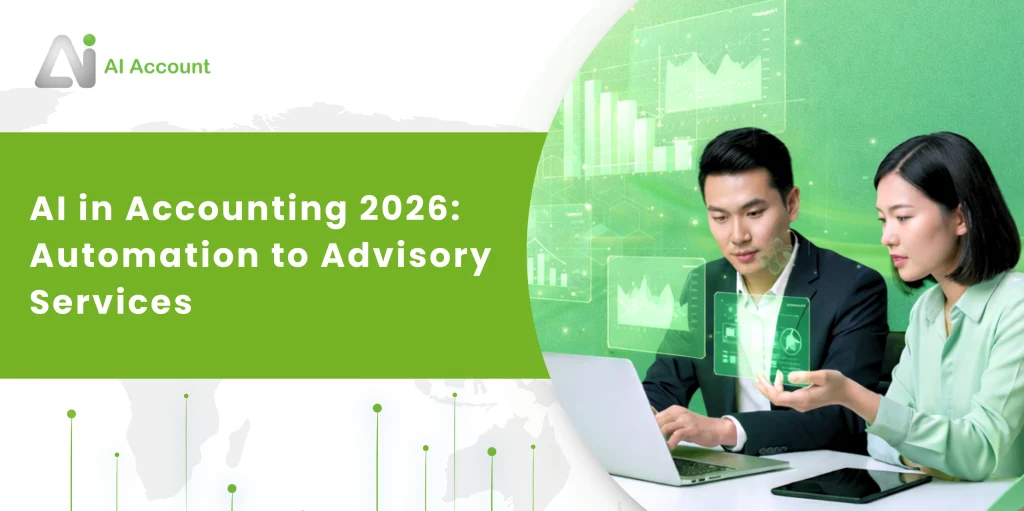
Can accounting firms survive on compliance work alone? The answer, according to industry data, is increasingly no.
According to the 2025 Future Ready Accountant report, 94% of U.S. accounting firms now offer advisory or consulting services, and 63% consider advisory a core part of their practice. This shows a clear shift in the accounting industry, with firms moving beyond basic compliance work to deliver higher-value services.
This blog examines how AI is reshaping accounting from compliance to advisory, what services firms now offer, and what skills accountants need to compete in that environment.
Table Of Content
- What Is AI in Accounting in 2026?
- Why Is Automation No Longer Enough for Accounting Firms?
- How Does AI Turn Accounting Automation Into Advisory Services?
- What Advisory Services Do AI-Driven Accounting Firms Offer in 2026?
- How Can Accounting Firms Use AI for Predictive Financial Analysis?
- What Skills Do Accountants Need in the AI-Driven Accounting Era?
- Conclusion
What is AI in Accounting in 2026?
AI in accounting refers to systems that operate continuously, process transactional and financial data, learn from historical behaviour, and produce judgments that influence financial reporting, risk management, and regulatory compliance.
Judgments that were once exercised by individuals are increasingly carried out by machine-driven systems operating across the organisation.
Why is the traditional accounting cycle no longer dominant?
For decades, accounting was organised around periodic closure, a system in which financial clarity arrived only after transactions had settled and decisions had already been made.
That sequence has steadily broken down. By 2026, continuous accounting will have moved firmly into the mainstream. Global finance surveys conducted between 2024 and 2025 show that 62 per cent of companies with annual revenues exceeding USD 300 million now classify, reconcile, and validate transactions on an ongoing basis rather than at fixed intervals.
Among these organisations, the average monthly close has narrowed from seven to nine days to fewer than four, while the volume of internal adjustments during the close has declined sharply.
Time once spent assembling numbers is increasingly redirected toward interpreting information in real time, reshaping how financial insight is produced and used.
How did Accuracy Become a Computational Problem?
For much of modern accounting history, accuracy relied on a series of human checks as financial records were transferred from preparers to reviewers, and this procedure guaranteed dependability but became more expensive as transaction volumes increased.
This has been reshaped by AI systems trained on millions of historical transactions, moving error detection earlier in the accounting process by identifying misclassifications, duplicate entries, and anomalies by spotting deviations from established behavioural patterns rather than depending only on predefined rules.
Why is Automation No Longer Enough for Accounting Firms?
For much of the last decade, accounting automation was cast as the industry’s answer to inefficiency, a practical fix for labour-intensive processes that had long defined the profession. Accounting software reduced manual intervention, accelerated transaction processing, and lowered the cost of routine functions across bookkeeping, bank reconciliation, payroll accounting, and baseline regulatory compliance.
By the mid-2020s, these capabilities had been broadly implemented across accounting firms and corporate finance departments alike. As automation in accounting became ubiquitous, it ceased to confer strategic advantage. Tools once associated with innovation were absorbed into standard operating practice.
1. When Automation Becomes Ubiquitous?
- As automated accounting software spread across firms of every size, it lost its point of distinction.
- Faster transaction processing and lower error rates became assumed outcomes of modern accounting systems.
- Clients no longer described accounting automation as innovation. They treated it as baseline infrastructure.
2. Cost Reduction Reached Its Limits
In its early phase, automation in accounting produced measurable cost savings across the profession. Accounting automation software reduced reliance on manual labour, accelerated transaction processing, and lowered operating expenses tied to routine financial work. By the mid-2020s, however, those gains began to plateau.
Once bookkeeping, bank reconciliations, payroll accounting, and standard regulatory compliance workflows had been automated, accounting firms found few remaining opportunities to drive additional efficiency through automation alone. Margins stabilised, but revenue growth slowed. Automation improved the delivery of existing accounting services, yet it did little to broaden their scope or materially change the value clients derived from them.
3. Clients Began Asking Different Questions
As financial reporting became faster and more standardised through automated accounting systems, its value began to be reassessed. Speed remained expected, but it no longer carried the weight it once did. Reports produced quickly and consistently through accounting automation came to be viewed as a starting point rather than an outcome.
The emphasis shifted to interpretation. Clients were less interested in how rapidly financial statements could be delivered and more focused on what those statements disclosed about performance, risk exposure, and future direction. They wanted to understand what was driving the results, where vulnerabilities were forming, and which decisions those signals should inform. These were questions of judgment and context, areas where accounting automation, on its own, proved insufficient.
How Does AI Turn Accounting Automation Into Advisory Services?
AI turns accounting automation into advisory services by changing the purpose of financial data from recordkeeping to interpretation. AI-powered accounting platforms now analyse financial information as it is generated. The shift reflects a reordering of how value is created inside accounting firms.
Instead of delivering completed reports after decisions have been made, AI in accounting enables continuous analysis that informs decisions while they are still being formed.
1. Real-time financial interpretation:
AI-driven accounting systems continuously evaluate transactions, cash flows, and performance indicators, allowing accountants to explain movements, trends, and deviations as they occur rather than after the reporting cycle closes.
2. From output to insight:
Automated accounting software produces standardised financial statements efficiently. AI layers analytics on top of those outputs, translating figures into explanations about profitability, cost behaviour, liquidity, and operational efficiency.
3. Early identification of risk and opportunity:
Using machine learning models trained on historical financial data, AI accounting analytics surface emerging risks, structural inefficiencies, and growth opportunities before they become visible in traditional reports.
4. Scalable advisory services:
AI enables accounting firms to deliver financial advisory, business advisory, and strategic insight consistently across clients, including small and mid-sized businesses that previously lacked access to such services.
5. Repositioning the accountant’s role:
As automation manages transaction processing and compliance, accountants focus on judgment, scenario evaluation, and client guidance. Advisory becomes a function of interpretation, not volume.
Advisory services arise where financial data is no longer treated as an endpoint, but as a source of direction
How Can Accounting Firms Use AI for Predictive Financial Analysis?
For most of its history, financial forecasting relied on extrapolation. Past performance was adjusted, assumptions were layered in, and projections were produced that reflected informed judgment but limited foresight. The process was deliberate, manual, and often slow to respond to sudden change.
That approach is increasingly inadequate.
- AI-driven forecasting systems now evaluate financial data continuously, allowing projections to evolve alongside real-world conditions rather than being revised after they shift
- According to global CFO surveys conducted between 2024 and 2025, organisations using predictive analytics report forecast accuracy improvements of 25 to 40 percent, particularly in short- and medium-term cash flow projections.
Forecasting in this environment becomes less about predicting a single point in time and more about ongoing recalibration.
What Skills Do Accountants Need in the AI-Driven Accounting Era?
| Skills | Description |
|---|---|
| Data Interpretation & Analysis | Ability to interpret outputs from AI-driven accounting systems, dashboards, and analytics models |
| Financial Advisory & Business Acumen | Understanding business models, industry dynamics, and financial drivers |
| AI & Accounting Technology Literacy | Working knowledge of AI accounting software, automation tools, and analytics platforms |
| Predictive Financial Analysis | Interpreting forecasts, scenario models, and probability-based outcomes |
| Risk Assessment & Judgment | Applying professional judgment to AI-generated insights and exceptions |
| Regulatory & Compliance Expertise | Deep understanding of accounting standards, tax rules, and regulatory frameworks |
Conclusion
The transformation underway in accounting is no longer theoretical. Firms that have moved beyond automation to advisory services are retaining clients and expanding margins. Those still focused primarily on compliance are struggling to compete.
AI Account has emerged as one response to that pressure. We provide smaller and mid-sized firms with predictive analytics and advisory capabilities they could not otherwise afford to build. The technology allows them to offer strategic guidance to clients who increasingly expect it.
The broader question facing the profession is whether it can retrain fast enough. The skills that mattered for decades, such as precision, process, and regulatory knowledge, remain necessary but no longer sufficient. What clients want now is someone who can tell them what the numbers mean and what to do about them.
Ready to Transform Your Accounting Practice?
Start delivering the insights your clients expect without building the infrastructure yourself with AIAccount
Recent Blogs

A User-Friendly Approach to Tailored Financial Solutions

The Advantage of a Private Cloud: AI Account’s White Label Package

-
Tommy Teo
(Author)
Frequently Asked Questions
What is the difference between accounting automation and AI in accounting?
Accounting automation handles repetitive tasks like data entry, invoice processing, and bank reconciliations using predefined rules. AI in accounting goes further by analysing patterns, identifying anomalies, making predictions, and generating insights from financial data. Automation speeds up existing processes; AI changes what accountants can do with the information those processes produce.
How much does it cost to implement AI in an accounting firm?
Implementation costs vary widely based on firm size, existing infrastructure, and the scope of AI tools adopted. Smaller firms using cloud-based AI platforms typically spend between $5,000 and $25,000 annually per accountant, while mid-sized firms building custom solutions may invest $100,000 to $500,000 upfront. However, firms that adopt platform solutions like AIAccount avoid large capital expenditures by paying subscription fees that scale with usage.
Will AI replace accountants?
No. AI replaces tasks, not accountants. The technology handles transaction processing, error detection, and basic forecasting, but it cannot exercise professional judgment, interpret regulatory changes, advise clients on business strategy, or navigate complex tax situations. What’s changing is the nature of accounting work: less time on data assembly and more time on analysis and client guidance.
Can small accounting firms compete with larger firms using AI?
Yes, and in some cases more effectively. AI platforms have democratized capabilities that were once available only to large firms with dedicated technology budgets. Small firms using AI can now offer predictive analytics, scenario modelling, and continuous financial monitoring to clients at scale. The competitive advantage now depends on how well firms apply the technology, not on their size.
What is the future of AI in the accounting industry?
The future of AI in accounting involves a shift from manual data entry to “invisible accounting,” where AI automates routine tasks, enables real-time, continuous auditing, and provides predictive insights, projected to grow by 30-40% annually. Accountants will evolve into strategic advisors, utilising AI for complex decision-making, while AI handles compliance, fraud detection, and financial reporting
How is AI used in accounting?
AI in accounting automates repetitive tasks like data entry, invoice processing, and bank reconciliations using machine learning (ML) and natural language processing (NLP) to increase accuracy and efficiency. It enables real-time fraud detection, predictive financial forecasting, and automated compliance monitoring, allowing accountants to focus on strategic advisory roles.
Lorem ipsum dolor sit amet, consectetur adipiscing elit. Ut elit tellus, luctus nec ullamcorper mattis, pulvinar dapibus leo.